
Arriving: Year 4
Berlin diary entries from 2025, translated
See notes from the previous years here: 2022, 2023, 2024. This is the last part (so far).
In my fourth year, I was finally getting more relaxed. Better English, better German, a bit more security after having gotten permanent residency. Better hold of the communities, knowing what’s cringe and what’s not.
But the biggest change hides in the changed tone of voice in my notes. I have the energy to engage instead of learning or consuming. I’m getting the hang of it. I can finally stop preparing for my new life and start living it.
I don’t know if it’s obvious from the photos that I attached to these posts, but while I was choosing them, going through all of my archives, I can see how my point of view changed visually, too.
In the beginning in Berlin, my photos were either “wow, look at this great thing” or “how weird is that?”. It was definitely a touristy approach. But in 2025, my photos became personal, less generic, more about my connection to Berlin. They are shot from a closer distance. I am in these photos, too — not only the city.
I am now a local, and this feeling will only increase later. Ich kenne mich aus — I know my way around here.
January 6
— This is so special, — a friend tells me, looking at the falling snow. We are dragging our feet through the slush because it is above zero and the snow is (unfortunately) already melting.
— What do you mean exactly? — I ask her.
— Walking in the snow, — she says, with a dreamy face. — That’s so pretty! We walk, and it dances above us.
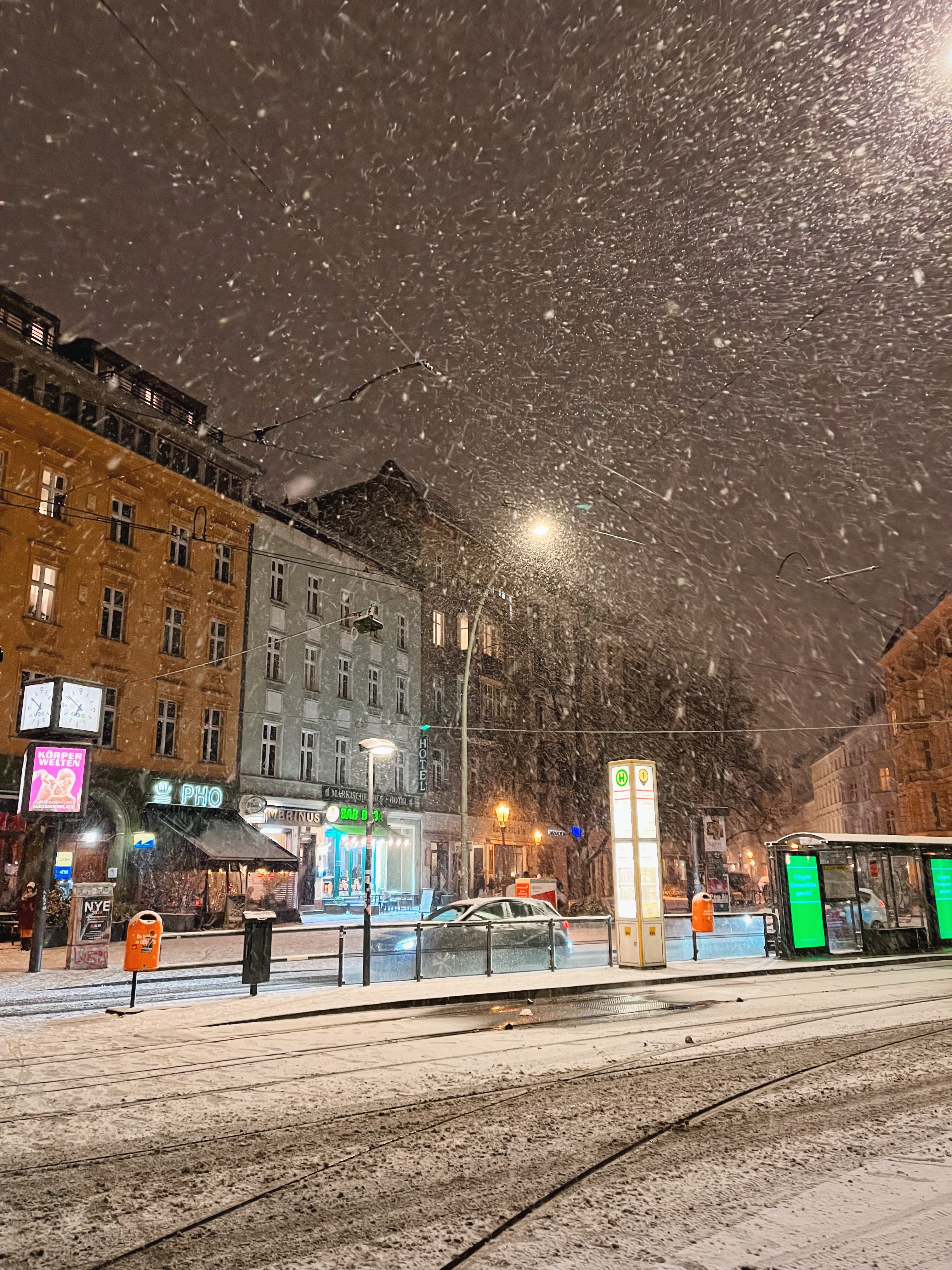
Because of what we both experienced as the norm in our lives before Berlin, we look at this snowstorm differently. What I see as “usual winter weather that we get rarely here” might feel unusual and magical to people who weren’t given many months of snow every winter for decades.
Here in Berlin, especially with climate change, snow comes and goes quickly, so it can be enjoyed and missed. You don’t get tired. The slush won’t stay until April. Maybe you get cold though, because you don’t have long socks and proper gloves. Me, I’m prepared for every cold-ish weather.
We say our goodbyes. In my music app, I find a composition, “Snowstorm II. Waltz”. It feels like snow to listen to it. It felt fitting. It’s part of my mental space; I know where to find music for this weather.
So many musical compositions, books, and movies from my first culture are associated with snow. How ingrained is it in me that in winter it snows? How often did I reread Miss Smilla’s Feeling for Snow, translated into Russian? Always in the winter. In school, we spent a lot of time on Pushkin’s The Belkin Tales — The Snowstorm is the one I remember the best. I'm watching the 1964 movie while writing this.
I tried to imagine not having all these associations in my head, but failed.
January 13
Discussed food with colleagues.
People always ask if I miss food from Russia, and I try to explain that I missed food IN Russia. Because of two-way sanctions over the last decade, many products were banned by both external and internal authorities. We traveled abroad for smoked fish and decent cheese.
The easiest destination was Lappeenranta, a town in Finland close to the country border. It’s a half-day trip by car. There were buses going regularly from St. Petersburg — to the supermarket and back. To open up the visa and bring home some good groceries. You were allowed to keep up to 1kg.
— But I don’t eat cheese, — I add, — so I was mostly stocking up on jamón.
— Jamón? What do you mean?
I am confused. We traveled to the EU to buy jamón, and these people live here, able to buy jamón every time, have no idea what jamón is.
I look inquiringly towards the German colleagues.
— Parmaschinken?
It’s a similar idea but in German.
Yes! They know Parmaschinken. They are nodding.
My Italian colleague doesn’t know Parmaschinken. I try to explain how the dried meat is being prepared.
— Ahh! — she says, finally. — You mean prosciutto.
January 20
On Friday, went to the dinosaur museum with a friend. We chatted and had a great time.
On Saturday, went with a different friend for a Korean dinner. Gave her a birthday present. Walked in a fog and laughed.
On Sunday, went with other friends for sushi. We discussed dating, the Love is Blind TV show, and travels. Then it was time for our queer book club meeting, with “lasagna soup” and a discussion of all the books we’ve enjoyed this year.
Neukölln at night. We are walking back from the book discussion towards the U-Bahn. I look around and blurt out: “It is so cool to live in Berlin!” My book club buddies knowingly nod.
February 1
At a dating event in a lesbian bar, I noticed a cultural detail.
It was recommended to “leave your number” to a person you found interesting.
— What is my number? — I asked the organizer. — Did you assign me one?
They looked at me with suspicion.
— Don’t you know your own number? — they asked.
I thought about it. What was my number, after all? I remembered “We” by Zamyatin, a dystopian novel in which people are assigned numbers instead of names. Something didn’t add up.
In the end, I realized that they meant my phone number. How silly of me. I also realized that I have no idea what my German phone number was. I don’t call myself, after all. And even if I did — everything is saved on the devices, you just look for names.
If I exchanged contacts with Russian-speaking acquaintances, we would either add each other on Telegram, using a username instead of a phone number, or do the same on Instagram. Who uses phone numbers? It feels too formal and too personal, like a passport number. I am not used to giving it to people. Maybe at a dentist? But not to a potential friend or a date.
What will people do here in Germany with my phone number? What to expect? An SMS? A call? Write a message in the messenger app? Which one — Telegram, Whatsapp, Signal? I would be so confused after getting a phone number without any preferences of what to do with it.
To solve this mystery, I contacted my German friend, who explained the culture to me (again).
“So, for me it is completely normal to know my number by heart. And I’d say it’s generally expected!
Because you also tell it to people in shops, e.g. hairdresser, bike repair, any other service that calls you when the thing is done.
I would say it’s very normal to exchange numbers, and it’s considered the most reliable way to contact someone.
In my experience, the default is WhatsApp (never SMS), but I actually make a point to ask which messenger service people prefer, to avoid being ghosted because the person doesn’t open one particular app much.”
February 1
— Look how sunny it is today! — I tell a colleague during the video call. We live in different corners of the city, and both prefer working from home rather than meeting at the office, which is at least an hour on the U-Bahn from each of us.
He shivers slightly and raises an eyebrow.
— Well, even if it’s sunny, it doesn’t matter. It is COLD. Minus four degrees!
The call and then the working day are finished. I walk to the U-Bahn. I have after-work plans. In minus four degrees.
I enjoy the weather. It is fresh outside. Not too humid, therefore not too unpleasant. No need to wear a hat and mess up your hairstyle. Perfect.
February 5
In an art store, the employee is curious about my background.
— Are you German? Where are you coming from? — they ask, switching from their native English to jumpy German to make my life easier.
To make my life easier, they should have switched to Russian, but they don’t know that, and I am definitely German-passing: a white woman in functional clothing.
To make my life easier, they should have kept their silence and allowed me to pay without small talk, so I save energy on interactions with strangers.
But they don’t know that, and their accent feels British. Probably they are being polite as a favor. But it is not making my life easier at all.
— I am Russian, — I answer, — but I live here.
My idea was to explain that I am not a tourist but a local, using as little energy as possible.
But they notice something else: that I don’t identify with the “home city” I’d arrived in Berlin from.
— But how long do you live in Berlin? — they ask, looking at me searchingly.
— A couple of years.
I get why they ask. I hear a lot of discussions of when it is already allowed to call yourself a Berliner:in. Is it too soon to commit after two years? Should I hesitate until I am here for five full years, until then it’s not too real? The timeframe feels subjective.
— Only a couple of years? — they didn’t expect this. — And you already say that you are from Berlin? I have lived here for 10 years but still say I am from England.
I roll my eyes mentally. Ideally, I would not have this discussion at all. I don’t have any free power left to engage. But I agree that it’s an interesting thought experiment: how long is long enough?
I offer softly:
— Identity is flexible.
We both laugh. Me, with my rainbow accessories. The employee with lavender nails and long dangly earrings. It’s a queer city, and we know that identities are subjective. Self-determination should be supported. Why not to the locality, too?
If I don’t visit the country I arrived from regularly, if I don’t have any plans to leave this place, if I spend years in one place, then yes, I consider myself to be from here.
— Yeah, — they answer. — I get it. Maybe I should also start saying that I am from here. It does feel more fitting for the current version of me.
The current version of me smiles back and walks home. And home is in Berlin.
February 11
In Berlin, I often think of something to say in Russian, and then I translate a metaphor, a joke, or an idiom.
Something that I always used in Russian without thinking much about its literal meaning becomes really visible in the process of translation.
Defamiliarization (ostranenie in Russian) was first used in 1917 by Russian formalist Viktor Shklovsky in his essay “Art as Device.”
The idea is to take a step back and look at something well-known with a new set of eyes, as if you’re seeing it for the first time.
Emigration is the essence of ostranenie. You always catch yourself on an insight about something you haven’t noticed about your first language before. You obtain a new lens and a healthier distance for observation.
Sometimes, a neutral phrase I’d used without reflecting in Russian sounds specifically cruel or harsh in English.
“In these situations, we usually say: their hands are growing from the ass.”
Sometimes I notice how weird something is that I’d just translated from Russian — because of the surprised and/or shocked stares.
Once, I’d said at work, “We don’t have to go all in; we can just get it with a small blood.” My designer looked at me with fear. But the thing is, this phrase was completely safe for work in tech back in Russia for decades. Sdelat’ maloy krov’yu, to make with a small amount of blood, just means not overextending yourself. Russian culture is the culture of suffering, so suggesting to suffer less is a polite, caring gesture. As I write this, I understand how weird it sounds in English.
And sometimes, I translate a joke or a metaphor, a neutral turn of phrase for me, but for a foreigner, it’s suddenly very, very funny. Here are some recent examples.
A joke:
A man kept talking about himself the whole time. Then he paused and added, “Why do I keep talking about myself? That’s impolite. Let’s talk about you. What do you think of me?”
A comparison:
They packed into the carriage like herring into a tin.
A name for the flirty period in the beginning of the relationship:
the bouquet-and-candy phase
A joke that explains the paradox of feeling lighter after you’ve gone through something tough and then it was over:
Buy a goat, and then sell a goat.
An explanation of not wanting to do anything together with someone:
I wouldn’t sit in the same field as them to take a shit.
A sarcastic, supportive toast for someone who is grieving that a special person left them:
Let those who didn’t get us cry. Let those who didn’t want us die. 🔪
February 23
Today is a political day.
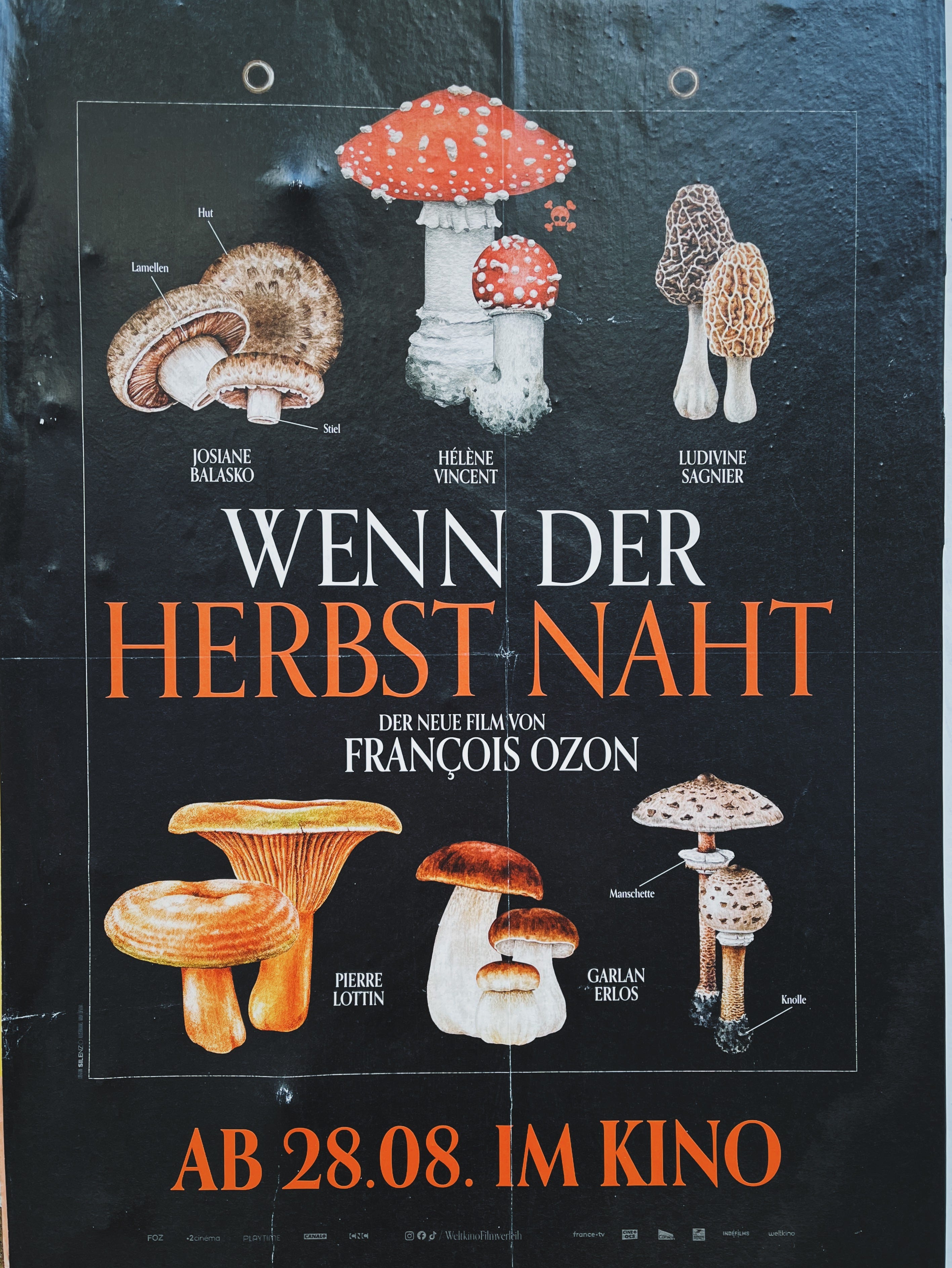
At Berlinale, I watched the movie My Undesirable Friends about independent journalists. This was only the “Part 1,” but already 5 hours long. I cried all the way. It’s a documentary.
After that, I traveled to the Russian-language Wahlparty, a fan event for the “Kanzler and Berghain” podcast. The hosts are a political analyst and a political journalist. The event helped Russian-speaking newcomers better understand how elections work in Germany, even if we don’t have the right to vote yet.
We came here because we wanted to participate in fair elections for the first time in our lives. It’s still pending; we need to wait before applying for passports, and no one knows whether the requirements for citizenship will change in the meantime. But we want to be prepared if we are able to vote for real for the first time. We want to study how the Bundestag and Bundesrat work, what a president does, and which parties are fitting our belief system.
The first part of today was reliving the past, and the second, hoping for the future.
March 12
I asked DeepSeek, the LLM of my choice:
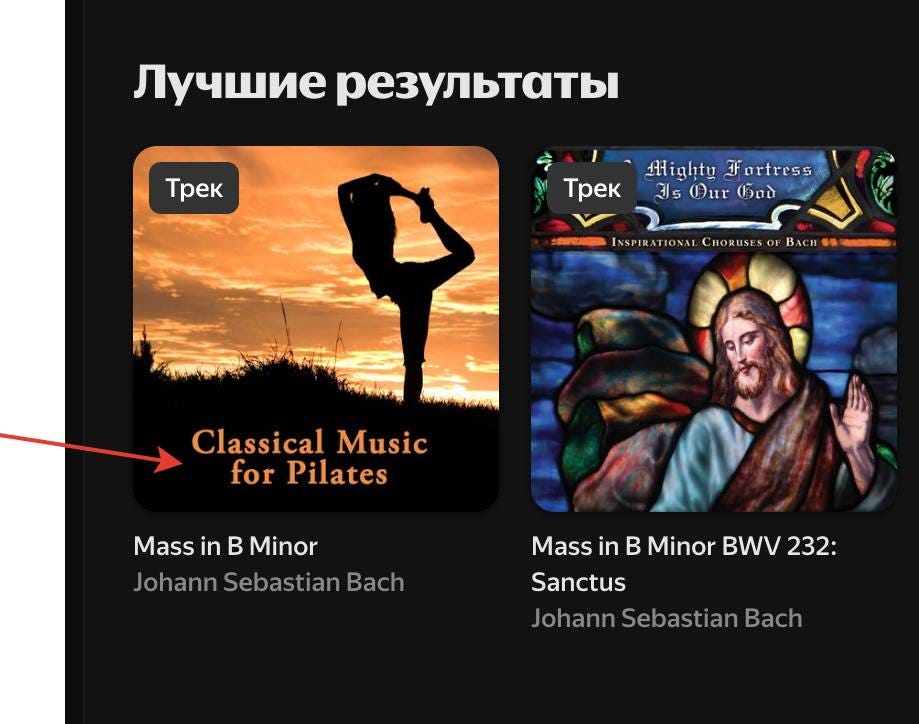
— Do you think Bach would be offended that we are listening to his sacred works from the phone now?
It answers:
— This is a fascinating question! It touches on the intersection of art, religion, and technology, and it’s worth exploring from multiple angles. Let’s break it down…
I think that Bach would be offended. Here is what I see in my music app:
April 6
— How do you feel during these spring weeks? — a German acquaintance asked.
— Amazing! — I beam. — The winter is so pleasantly warm and short here. We haven’t even started feeling it, and it’s already over. Flowers I would expect to see in St. Petersburg in May-June are already out here. I feel energy returning to me. I want to walk, look at everything, take pictures! What about you?
She looks suspiciously not energetic.
— Do you know the word Frühjahrsmüdigkeit? Being tired because spring has arrived?
I don’t.
— Could it be that I feel tired because I know this word? — she thinks aloud. — Am I culturally conditioned to be tired after winter?
April 12
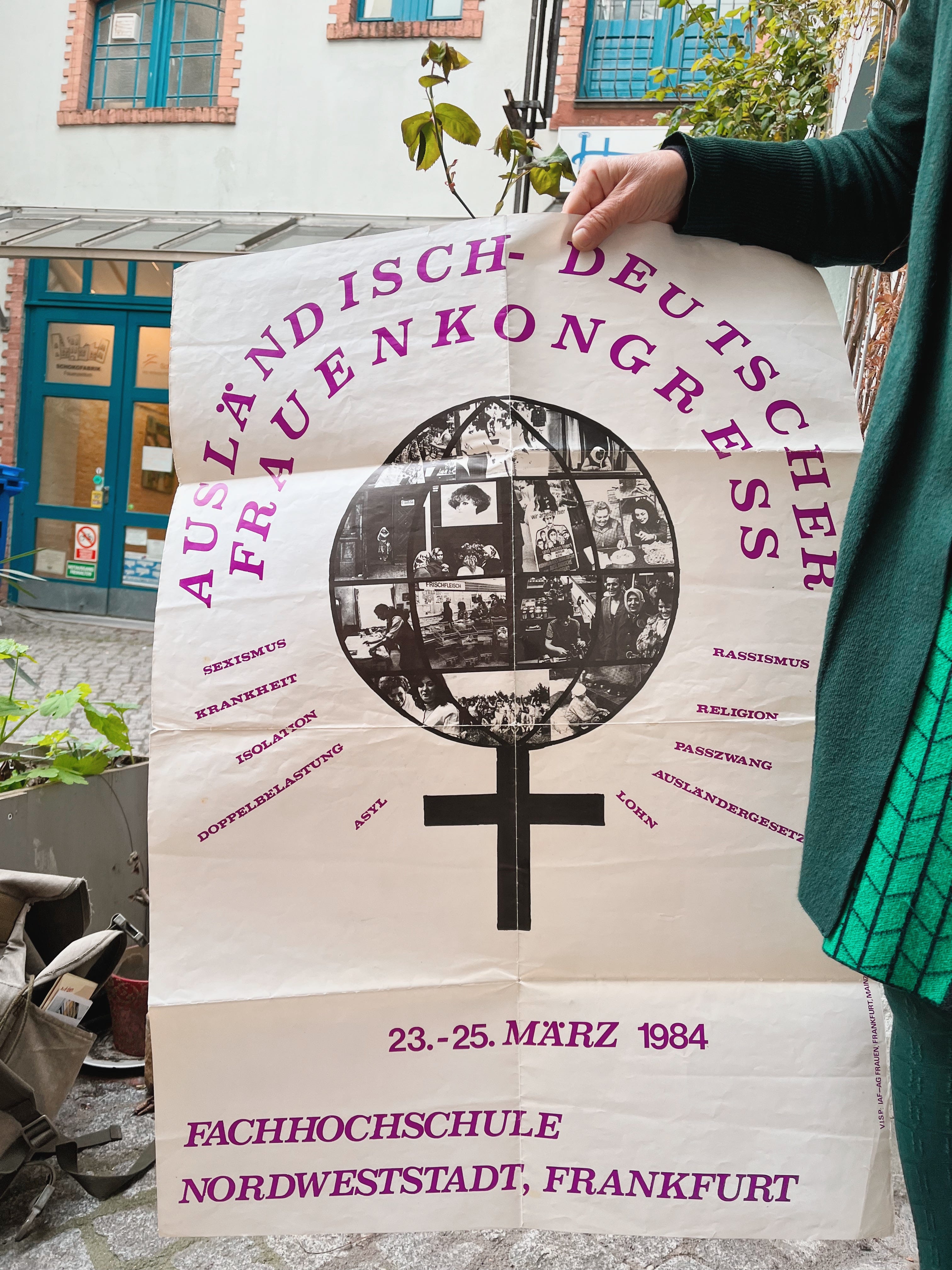
Took a guided tour, Stadtrundgang zur migrantischen Frauenbewegung in Kreuzberg, with Berrin Önler-Sayan.
It was so interesting, and I could understand most of what Berrin was telling us. I was lucky that she speaks clearly and not too fast; my German is not too strong yet.
But the most fascinating thing was that Berrin doesn’t just tell the story; she tells the story she’d lived through. She arrived in West Berlin in the 70s and saw everything firsthand.
Berrin. Her name is so similar to Berlin.
The guided tour was based on her essay Zur Migrantinnenbewegung der 1970/80er-Jahre in der Bundesrepublik. I really hope people will write books and make movies about widely forgotten stories that Berrin still remembers.
Imagine that I was not even born yet, but Berrin was already organizing a feminist migrant festival in Frankfurt, with only a telephone and some personal contacts as resources.
April 20
Immigrants in Germany who work in tech are always wondering why cash is still so popular here, and why Datenschutz is a thing.
But let’s just look at my German course book of the C1 level.
Formulate sentences from these words to create Terrible Visions of the Future.
I’ll spare you some time and share the correct answers from the book with you.
In 100 years, everyone will live in huge cities.
Giant computer systems will monitor people.
You will be watched around the clock.
Water will become a luxury.
No one will be able to eat fruit.
Many will be confined to underground labor camps.
We will be allowed to read only what computers write.
Your texts will not be able to circulate freely on the Internet.
April 19
While preparing for a karaoke bar visit, I learned that the video clip Don’t Look Any Further by M People was filmed in Berlin in 1993. Now, it feels like a chronicle.
But I wasn’t able to prepare well because the bar's song selection didn’t match anything I could sing (given what I know and my lack of a good voice).
It also turned out that my friend who invited me listens to completely different stuff.
I started looking for Billy Idol (because I like “Rebel Yell”, a song that I learned in the 90s through Scooter’s cover, and then found the original).
— Billy who? Billy Eilish? — asked my friend.
I don’t know her songs, so my friend suggested singing the lesbian classic, the main song by T.A.T.U. — good idea, even if theoretically.
I agreed because I have heard the original a million times in the 2000s. I can sing it with my eyes closed. But! I only know the Russian version, “I lost my mind”, not “All the things she said”. Turned out that when they were translating the text, they also adjusted some of the musical parts. I don’t know the English words, and the beat is a little different too.
My friend didn’t know East 17 and hadn’t watched their video clips with fun hats. I didn’t know any current music.
The only song we both remembered all the words for and could sing together was, for some reason, Coolio’s hit of 1995, Gangsta’s Paradise 🔫 (we sang it 3 times, and then our time was up)
May 2
When I was still finishing German B2 level, a friend told me that the next one, C1, contains peculiar content. She was prepping for a C1 exam, and many exercises focused less on grammar or phrasing and more on reading intonation and intent. Was this one earnest or ironic? Are they mocking you?
Then, I didn’t fully get what she meant. Is using words as a passive-aggressive weapon the higher level of knowing a language? But now, since I am studying at the C1 level myself, I can observe the same.
Let’s look at my homework: I need to shit on someone’s presentation ironically, using words from the list. Here are the correct answers from the workbook:
Was für ein gelungener Vortrag! - What a successful presentation!
Warum sich vorbereiten, wenn’s auch ohne geht? - Why prepare at all when you can do without?
Er wollte wohl unsere Intelligenz testen. - He probably wanted to test our intelligence.
Kleiner ging’s wohl nicht mehr! - They couldn’t have made it any smaller!
Durch bessere Betonung hätte der Vortrag ja interessant werden können. - With better emphasis, the presentation could actually have been interesting.
Man gönnt sich ja sonst nichts! - You’ve got to treat yourself now and then!
May 19
For some time now, I have wanted to take a course at the adult education center (VHS). It’s not about ‘adult’ topics, but it’s for adults. A school for older people: languages, hobbies, etc.
There is one VHS in my area, a pretty building. Every time I walk past, I see people studying and I envy them. It feels like they are having fun. I wanted to have it, too.
But most of the interesting things happen in German, so I needed to get a better grip on it (and learn to recognize sarcasm!). Now I feel ready, so I booked a birdwatching lesson at a cemetery — who could’ve said no to that?
I had also been planning to visit this cemetery, the Alter St.-Matthäus-Kirchhof, for a long time. There is a brother Grimm grave. There are rock stars. There are gay activists.
The group's guide is a grey-haired biologist. She is retired but very energetic and engaged with many social projects. I’d also seen her in Südblock, the queer cafe at Kotti. I can read her as queer, or at least lesbian. She speaks German quickly, but I can understand her. The group consists of older white German ladies; I am the only foreigner, but I manage short answers without a noticeable accent and don’t go into lots of small talk, politely smiling, so one asks where I am coming from. I like not having to explain myself. Just existing. That’s definitely the privilege I get as a German-passing white person.
On the tour, I learned a lot about Mauersegler (swifts). Mauersegler, literally wall sailors. Their crooked feet are not fit for walking; they don’t land on the ground — they wouldn’t be able to lift off it. They spend their time in the air and attached to the wall. Wall sailors.
I’ve seen a woman riding a bicycle to the cemetery. A cat calmly sat in a bicycle basket on a leash. Once the woman arrived, she parked the bicycle and set the cat down. The cat confidently walked, not attacking the birds, just sniffing the grass. The woman followed at a leisurely pace, her hands clasped behind her back.
At the end of the walk, we found the Nachtigall (nightingale). Nachtigall, the singer of the night. I prefer the name in Russian, solovey, it is floatier. You could even tenderly say solovushka. We learned that Berlin is a special place for nightingales. There is even a nightingale research area on Tempelhofer Field.
I also learned about the German service for reporting the birds: ornitho.de. It is not UX-friendly, but they collect an enormous amount of recent data from passionate birdwatchers across the country.
I think my Merlin app (or, as I say, Shazam for birds) is enough for now. But it’s really cool that VHS offers guided tours like this one. Everyone in the group was excited and ready to learn something or share their personal birding experience. Hobbies in Germany are practiced and shared with a great intensity.
I wondered if that’s fair, though, that Germans request that their house be blurred on Google Maps panoramas but will watch a bird’s nest with binoculars. Seems like Datenschutz only applies to humans.
June 7
I am thinking a lot about the current wave of Russian emigration, especially in Berlin — because 100 years ago, Berlin was already once a welcome port for Russian emigrants, mostly aristocrats and political activists who didn’t vibe with Bolsheviks.
After listening to a lecture series on this subject last year, I now ordered Roman Utkin’s book Charlottengrad: Russian culture in Weimar Berlin. There, I found two poems about Berlin. They were written by people who had to leave Russia at a different time for a similar reason. We share the city, but not the time.
by Boris Pasternak (1923)
Why must life put up with such eccentrics
As every day for a small token
It passes for revue over the abyss
Hurrying from Potsdam as the sun goes down?
He passes out roses and mignonettes
From a basket, at the cornerstone that he rents,
Where he argues with semaphores about what beauty is
Smelling of benzene — with snow in the distance.
His hand points to roofs, pipes, an untouchable person
But not the twilight, — using a pencil for make-up.
As you merge there with the darkness, the subway train’s
Grimace blows away on the wings of smoke.
*
by Vladislav Khodasevich (1923)
Everything is stone. Into the stone archway
The night retreats. In doorways, by the gates —
Like statues — couples stuck together.
A heavy sigh. And the heavy smell of a cigar.
A key clinks against stone, a bolt rattles —
Walk on the pavement till five o'clock,
Wait: a sharp wind will blow through the ocarina
Through the drainpipes of towering Berlin —
And a coarse day will rise from behind the rooftops
Over the stepmother of Russian cities.
July 15
A person who moved to Berlin in 2022 and me-today are two different people.
We are distant relatives at best.
August 6
At work, I am pushed to organize team events “to keep people engaged.”
I hate team events as an introvert (planned fun, ugh), but I understand that, as a team lead, it’s part of my job. I suggest everyone shares a couple of things we could do together, and then we vote for them.
No one votes for my idea of GDR museum. I try to argue:
— But you don’t know that part of the story because you didn’t grow up in Ostblock. I thought it would be interesting and that I might be able to explain some things, since I had a similar childhood!
They are not impressed. GDR history is no longer relevant. It is “too sad.” They want something “fun.”
A colleague suggests something else:
— I found this! Looks so interesting, doesn’t it? A prison escape, haha!
I scroll the website, feeling my insides swirling. There are political prisoners who are in prison in Russia, in Belarus, and in other countries now, tortured, slowly dying without health care, human contact, and enough food.
New action experience in Berlin: prison escape!
It is a team game with 30 different rooms, each one a mix of physical, mental or tactical challenges. You go in as a group and try to collect as many points as possible by solving tasks under time pressure. It’s like a mix of escape rooms and game shows, but more playful. The whole thing takes about 1.5 hours.
Good for groups of friends, families, birthdays or even team events. Suitable for anyone over 7, and the place is also wheelchair-friendly.✌🏼
Have fun!
Solving tasks under time pressure is all I've done in my previous year in emigration. I don’t want to return there. And I see no fun in the description.
I see a person behind the prison bars in the Instagram reel. The person is smiling. The discount code is flashing.
I won’t do that if they pay me.
But I am a team lead, and it’s a suggestion from a team member. I need to be professional, and I cannot show how hurt I feel or ask them to stop suggesting things that give me PTSD and require me to explain myself.
I try to joke it off:
— You know, that could prompt a panic attack, to be honest. I already escaped somewhere once, and I don’t want to do it again 😆
The colleague understands the hint, but the knot in my stomach stays for hours.
In the end, we go axe-throwing together.
I don’t throw an axe well at all, going for it too softly. The same colleague suggests I imagine “someone bad” instead of the target.
The next throw is successful, and everyone cheers.
September 20
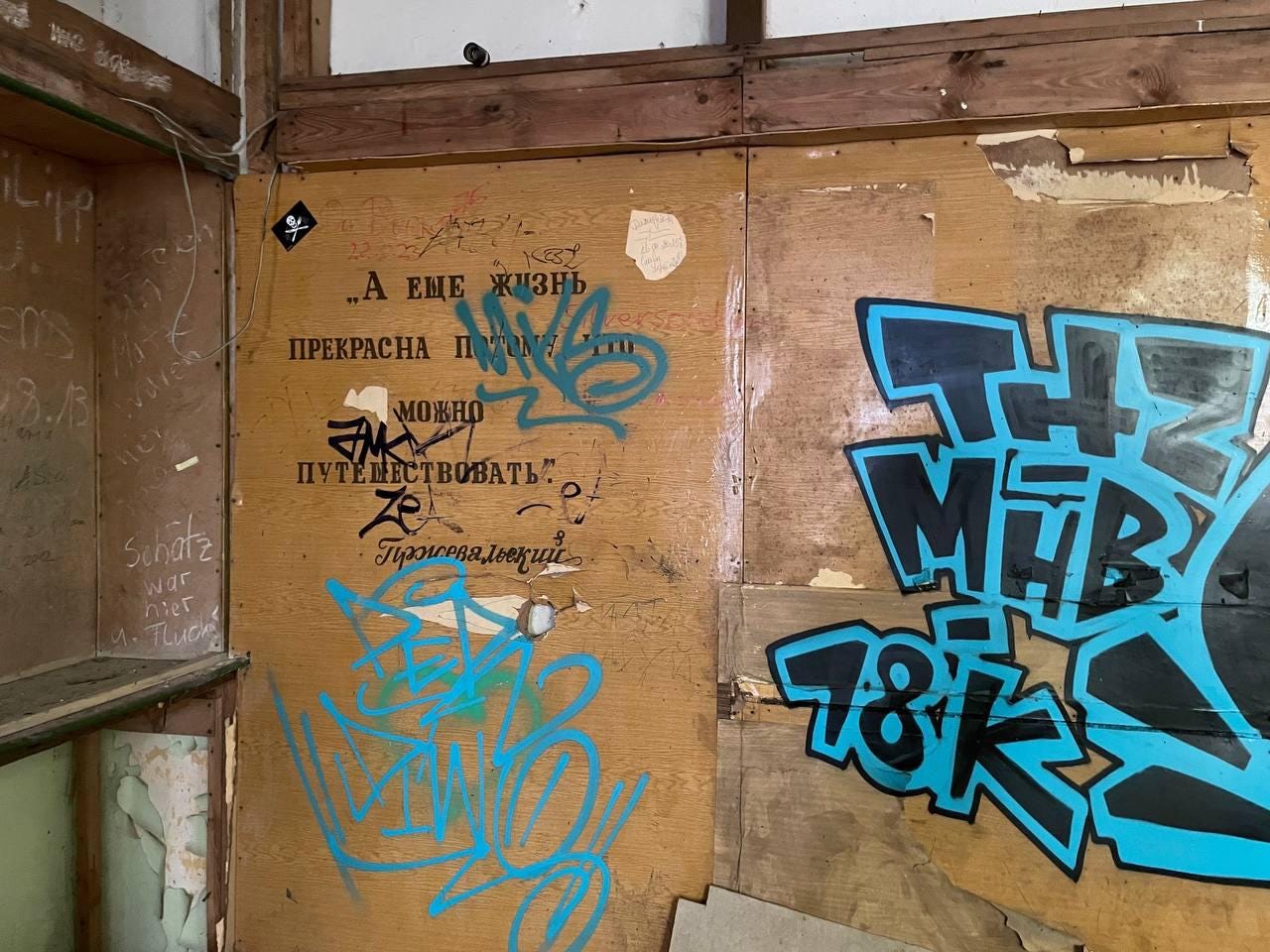
A friend was biking around Berlin and discovered an abandoned building from GDR times. She sends me a photo so I can help her decipher what is written on the wall in Cyrillic. There is graffiti on the top of some words, and some are not clearly seen.
I can read it right away. It’s the quote that was usually written under the portrait of its author in the school's Geography class.
And life is also beautiful because you can travel.
“It is about you,” I write to my friend. She enjoys traveling.
October 19
A message in the chat for Berlin-based English-speaking writers:
Hello, I have started a small cute weird independent writing school, and in particular, I am low on enrolment for my creative writing class which starts tomorrow (weekly/ 6 weeks/ sliding scale and soli spots). We are reading and writing alongside women who killed someone, or tried to, or were convinced of it. If you are interested or know ppl who are pls let me know!
October 19
For six months, I was a part of a German-language mentorship program. People accepted as mentors and mentees identify as lesbian. The project aims to support people's professional growth and create a supportive queer community. It’s funded by the city administration.
The main challenge was that I entered as a mentor, not exactly sure whether my level of German was enough. That was quite ambitious.
But at the same time, if I work in English every day and socialize in English, I have no hope to get fluent in German without a natural way to use it. Only learning won’t cut it, I need real-life examples and communication. So I dived with my head down, as always.
Everyone in the program was super supportive. Of course, I was constantly cognitively challenged. All the Rahmenprogramm is in German — supervisions, workshops, common gatherings.
My mentee was also a 2022 immigrant, from another country though. She is also still learning the language, and I suggested we switch into English. She disagreed. She works in German and we both needed practice. I rolled my eyes internally, not getting away easily, but agreed that she is right.
After our first meeting, I was so cognitively empty and physically tired that I wanted to lie down on the ground and stay there forever.
By a titanic effort of will, I pulled myself together and had a ramen at Ronin, after which I had enough energy to ride the U-Bahn home. Next meeting went way better (maybe because I was looking forward to the ramen).
November 11
— I don’t remember the English word for it, — a German person says. — But in German, it’s Scharnier.
— ШАРНИР!! — I yell. I know this one in Russian, but also have no clue how it is in English.
I created a spreadsheet for such cases, and it keeps growing. It has over 700 examples of words sounding similar in both languages. I haven’t seen such an overlap of Russian with any other non-Slavic language I was learning before.
The explanation is that cultural collaboration between the cultures was historically significant, for good and bad reasons. Accountants are called buhgalters in Russian (from Buchhalter), and bras are called byustgalters (from Büstenhalter). A one-sided sandwich is buterbrot in Russian. I can go on for a long time.
The English-speaking people around us don’t have any Scharnier in their languages. They sigh and reach for the dictionary app.

November 23
I see a lot of content from emigrants (whether in Berlin or not, whether Russian-speaking or not) about “looking for friends as an adult.”
For me, looking for my people in Berlin was essential. Having moved alone, I needed to find people who are safe, fun, and deep. Later, I learned that this alone is not the challenge; finding people with the capacity and willingness to commit is the bigger question in Berlin.
I was also afraid to get stuck in the diaspora. I know that in the beginning, in a foreign place, you have the motivation to meet people, which might fade as you settle in. I wanted to use it for the more challenging task of socializing deeply in English on a daily basis (for the first time in my life). Finding people who speak Russian in Berlin is easy; an estimated half million (out of 4.5 mln) here speak it. So I pushed myself into English-speaking rooms.
Later, I learned that language is the least of the concerns. Yes, it is a cognitive load. But the values are way more important, and it wasn’t easy to connect with many Russian-speaking people, even if I wanted to. Our identities clashed — I was often the only queer in the room, the only single, the only without any contact with my family.
Our politics clashed — I was often seen as “too leftist” for things I’ve said that felt like common sense to me. A lot of people socialize only with Russian-speaking and white people, and as a result, I was often bringing up topics that people found “irrelevant” in their walled-up lives or that “bring the mood down.” I wanted to discuss my fears about potentially failing probation, and someone else wanted to discuss an upcoming vacation to Iceland.
— But what was the real reason for your emigration? — one online Russian-speaking acquaintance asked when we’d met in Berlin.
— The biggest was homophobia in my home country, — I answered earnestly. — I started looking for jobs when they started banning books.
— Ah yes, — she looked a little disgusted. — There is a lot of THIS in Berlin.
I think I’d met hundreds of Berliners, Russian-speaking or not, and tried dozens of communities. I could stick with some people and a couple of spaces. Then my newfound friends left Berlin, changed their capacity for friendship, or no longer vibed with me.
It was a lot of emotional whirlwind, but finding regular rooms I feel welcome in (local yoga, queer book club, reading group in German, lesbian mentorship project, etc) made it easier to cope when I lost my main close friend in Berlin, again.
Another thing that made it easier was staying in touch with my Russian-speaking online friends.
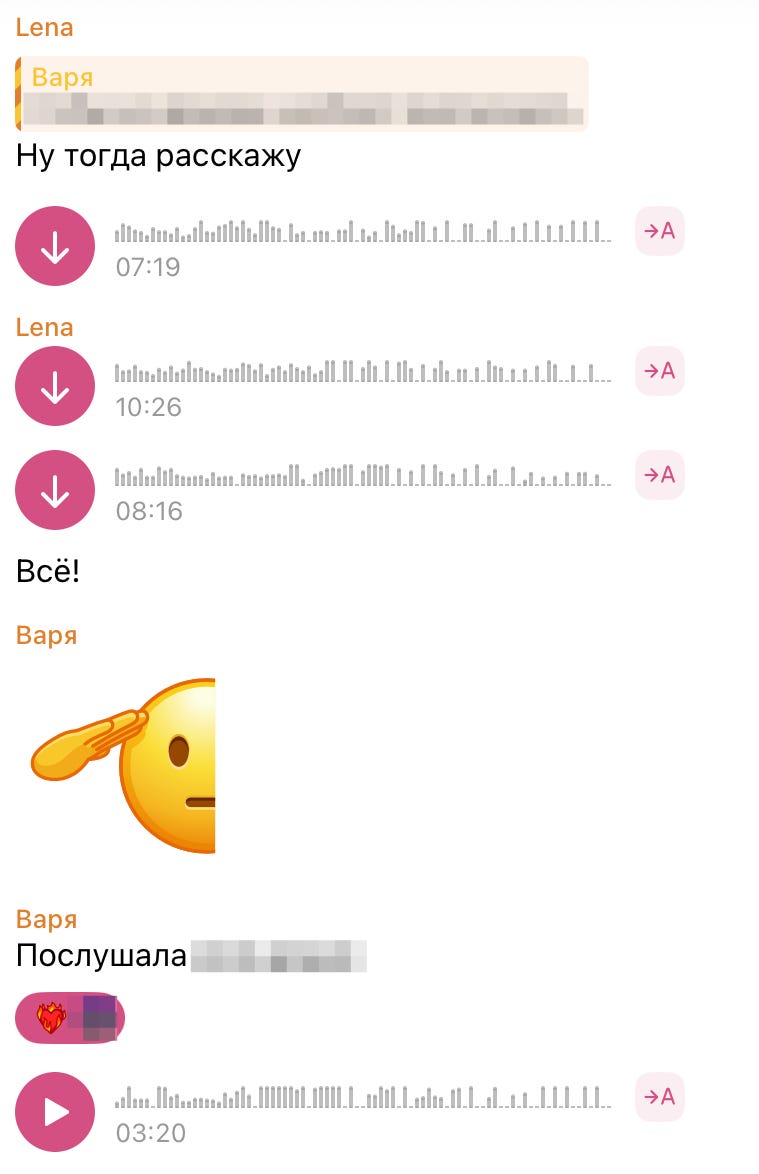
I was right to prioritize finding local friends and communities because we are animals and animals get happy chemicals from being safe with other animals.
I am very grateful for all the online connections that stayed strong despite my Berlin dramas and lower emotional capacity, with English and German words peppering my Russian. My friend V. said that I didn’t look like myself in the first few months after the emigration. If you’d read the post from the first year, you’d see why.
I am grateful to have people in my life who are close to me and who also have their own drama, wins, and losses: in Hawaii, Egypt/Armenia, Niedersachsen, St. Petersburg, or somewhere else.
November 26
My yoga teacher has a great sense of humor. I am having fun every time. First, at the B1 level, I could only understand some of her instructions and did not speak fast enough to join the banter. But I kept climbing up, and now it’s an exception when I don’t know what is happening. And people gladly explain to me, too.
After changing from a dog-muzzle-down (literally sobaka mordoj vniz in Russian) to the child pose, the teacher says something that I cannot decipher. Kin! But what is a kin?
— Look up, — she says. — Look at me.
I do. She is touching her chin. She wanted me to keep my chin in a different position. Understood.
— Das Kinn, — she says.
When the lesson is over, both a yoga and a linguistic one, I roll up my mat, ready to share something.
— Do you know how das Kinn is in Russian? — I ask, knowing that she probably doesn’t.
— How?
— Unter Bart, — I share. — Under the beard.
Now she is curious:
— Could you say in Russian?
— Podborodok, — I shrug. It’s a simple word.
She doesn’t think it is.
— You know what? — She comes closer. — It is good that you’ve learned German.
She isn’t planning to learn how to say podborodok.
December 30
Time between Catholic Christmas and New Year in Germany is called Zwischen den Jahren, between the years. The time-out: something has already ended, and something else has not yet begun.
For me, that’s unusual. Catholic Christmas isn't on my mental map, and if it falls on a weekend, we don’t even get an extra day off. I am used to the full “hangover week” (pohmel’naya nedelya) after New Year, when nothing happens, everything is closed, and you can reflect on your past year without pressure. Or finish the leftovers.
I lost this time-out when I moved, and I need to adjust to the way the locals do it. I am now being pushed to reflect on my year before it even finishes. It feels wrong.
On a last work call before Catholic Christmas, my German colleague seems festive:
— It’s done! It’s officially done!
— Some things are done, but the year isn’t yet, — I offer. — It still feels incomplete.
My Italian colleague is curious:
— Do you celebrate on January 6 instead?
— No, — I offer, — I am an atheist.
She confronts:
— But here, not everyone who celebrates Christmas believes in God!
I understand, but I find it ironic that “Christ” takes up more than half of the word.
My German colleague is still happy:
— God or no God, the main thing is that my wife and I ordered all the presents for the kids and everything was delivered in time! We’re ready to go!!
My Italian colleague has challenges:
— My main thing is that my relatives cooked too much and are insisting I eat more.
What is my main thing? I still need to reflect on my year. I don’t know it yet.
Thank you for reading 🫶🏻
I am happy to hear your thoughts — in a comment or email.
Thank you for Year 4. The shift from preparing for a new life to actually living it really stayed with me. As an Italian in Berlin the jamón to prosciutto moment made me laugh, I have had that exact confusion.
We actually went to the "Prison escape" last year. Weird framing, but was fun 😅