
🤥 Soviet Fanfics
what if there is another variant of the story?
As a kid, I really enjoyed the story about the wooden boy with a pointy nose who wanted to fulfill his dreams. He got into some serious trouble, made friends and enemies, and, in the end, hit the jackpot.
If you thought that the protagonist was called Pinocchio, no, he wasn’t. The book was not translated from Italian but written in Russian. The wooden boy’s name was Buratino.
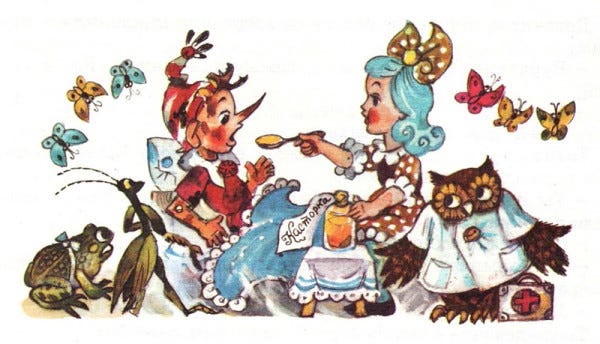
His goal wasn’t to become a “real boy”; after all, what is real? That’s subjective (and very Western). His goal was to get a golden key. His jackpot was to free the puppet theater from the tyrannical, imperialistic puppeteer Karabas-Barabas (I am not making this up). The goal was artistic freedom and a thriving creative community. In the end, Buratino, who initially exchanged the textbook for a ticket to a puppet theater show, rushes to attend school because he now understands that knowledge is power.
His nose doesn’t grow if he lies; it’s not Catholicism, and sins against the working class are punished differently. Instead of the Blue Fairy, there is a blue-haired Malvina, the dominant girl living in a forest with admirers, who hates people with bad manners. She usually rolls her eyes and sends boys to wash their hands before eating. Pierrot is a poet and somewhat queer-coded. Artemon, Malvina’s poodle, is usually played by a person in a dog costume, so a Furry?
In the popular Soviet movie, The Adventures of Buratino, produced by Belarusfilm in 1975, a Lady Turtle who knows how to get the golden key was played by Rina Zelyonaya. Every Post-Soviet millennial probably knows her song by heart:
The surface of the ancient pond is now covered in brown sludge.
Ah, I was once young, just like young Buratino!
The young turtle’s gaze was carefree and naive,
Everything around seemed wondrous 300 years ago.
Young friend, always stay young, don’t rush to grow up,
Be cheerful, bold, and boisterous! If you must fight—then fight.
Never know peace, cry and laugh for no reason,
I myself was just like that… only 300 years ago.
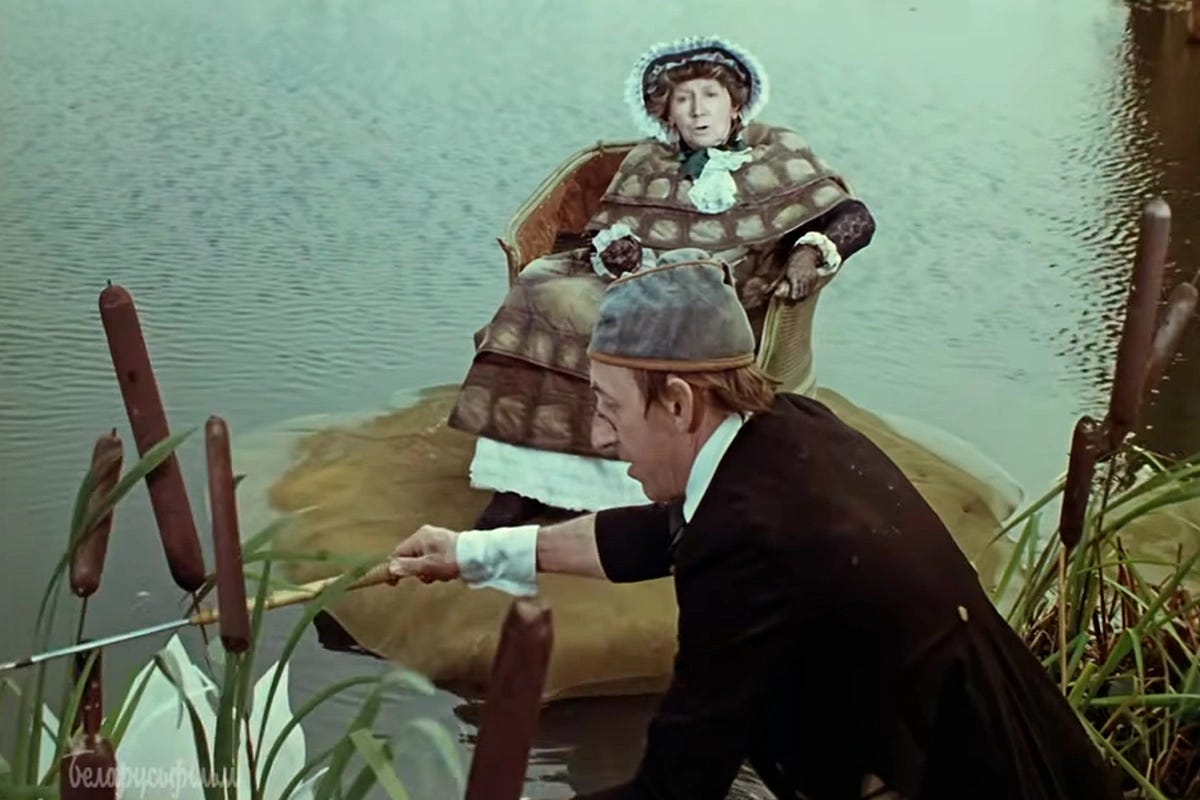
If you’re already confused, good, because it’s only the beginning. Building on the history of Soviet literature told in one of my previous posts, I’m touching today on the power of rewriting the narrative — when the narrative sometimes leaves the equation entirely to walk freely wherever it feels like.
Buratino
But who exactly created all this lore with Lady Turtle, the golden key, and the anti-imperialist fight?
Returning to Soviet Russia in 1909 after a period of emigration in Paris, Alexei Tolstoy (a very distant relative of Leo Tolstoy) soon left for Paris again. Later, though, he saw his son becoming too emotionally connected to the French language — a common concern among emigrant parents. It was painful for the father, the writer, who also felt disconnected from his country. He suspected that literature produced outside it would never be the same.
Tolstoy cautiously visits again and then returns permanently. Having built friendly relationships with the regime, he survived Stalin’s purges, produced some science fiction and was hired to adapt Carlo Collodi's Pinocchio.
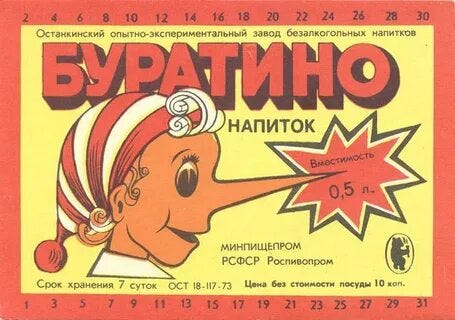
Tolstoy called his own story “a free remake” (vol’niy pereskaz), neither translation nor adaptation. It becomes very popular and stays so still. A popular lemonade is called Buratino.
There are more examples of free remakes.
Dr. Aibolit
“Ayyy bolit” is literally: “Ow, it hurts”.
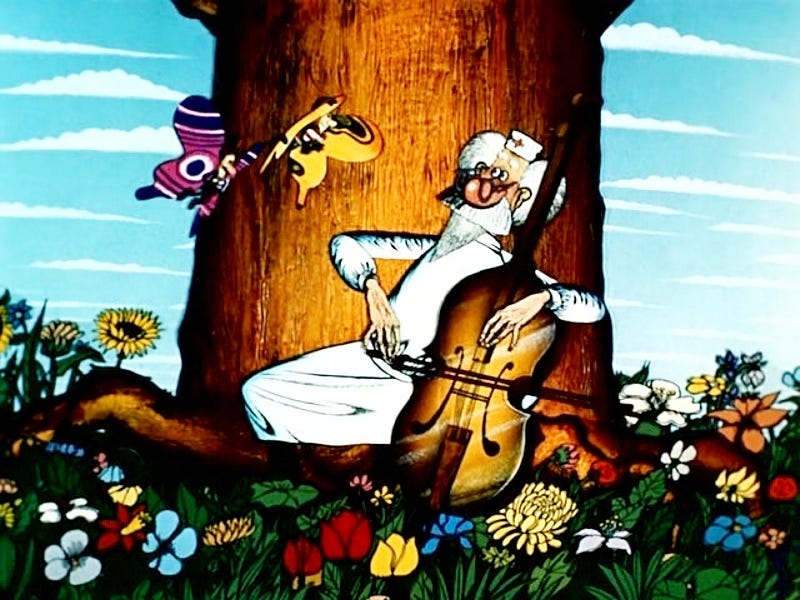
How kind is our Dr. Aibolit! He sits under a tree.
Come to him for treatment: the cow, the wolf,
The little bug, the little worm, and the bear!
He’ll cure and heal them all, our kind Dr. Aibolit!
This is an excerpt from the poem Aibolit, a loose adaptation of Hugh Lofting’s 1920 character Doctor Dolittle by the famous Soviet children’s writer Korney Chukovsky.
There was a living prototype of the main character: Chukovsky’s acquaintance, the Vilnian Jewish physician Zemach Shabad, whom he met in 1912, described in Chukovsky’s memoirs as “the nicest man I knew. Not only children visited him themselves, but also they were bringing sick animals.” The main villain (the evil pirate Barmaley) was also perfect, becoming an archetypal villain.
Chukovsky was a prominent literary figure. He translated a substantial portion of the Mother Goose canon into Russian and translated Walt Whitman, Mark Twain, Oscar Wilde, O. Henry, and other authors.
The Wizard, but not of Oz
In my childhood, I had two collections on my bookshelves.
One was by Lyman Frank Baum — starting with a little girl, Dorothy, with her little dog, Toto, looking for The Emerald City, quickly diverging into crazy (in a good sense) stories about:
a pumpkin as a talking head,
scary Wheelers who had wheels instead of hands and feet,
the yellow and kind hen Billina who could speak,
a princess who had many heads in the wardrobe and chose one every morning, setting at the same time her character for a day,
and — my favorite — a gender transition.
Another was by Alexander Volkov — starting with a little girl, Ellie, with her little dog, Totoshka, looking for The Emerald City, quickly diverging into crazy (in a good sense) stories about:
a pack of wooden soldiers that come alive,
a nation that lives underground and is ruled by seven different kings who are changed regularly,
an eagle, ruler of eagles, plotting against another eagle,
a magical black box that is showing the recording from the cameras, so the protagonists could see what the villains are about,
a source of the special water that helps a person to forget anything and be ready for a re-education without any resistance,
dragons and “Six-paws” (animals with six legs) used for agriculture.
Only the first book in both series is somewhat similar. Volkov quickly diverged from the original because he didn’t appreciate the way the story went. In 1958, he wrote:
I spent two days in the Foreign Languages Library, studying several books of Baum. I am convinced the first one is his best one: kind, funny. Others are quite strange.
All these yellow hens… mechanical Tik-Toks… Wheelers… changing heads of the princess Langwidere… it doesn’t have any cultural taste! American writers have an amazing passion for extremely long series.
I have to give my idea of adapting another Baum’s book up. There is nothing among these volumes that I could have told to Soviet children. I found some discrepancies in the stories as well. For example, Dorothy “defeats the last of the Wicked Witches in the Land of Oz,” but in the subsequent books, there are a great many of these witches and wizards... Oh well.
I’m starting thinking about a second book after the “Wizard of the Emerald City”, though. Created in a different way.
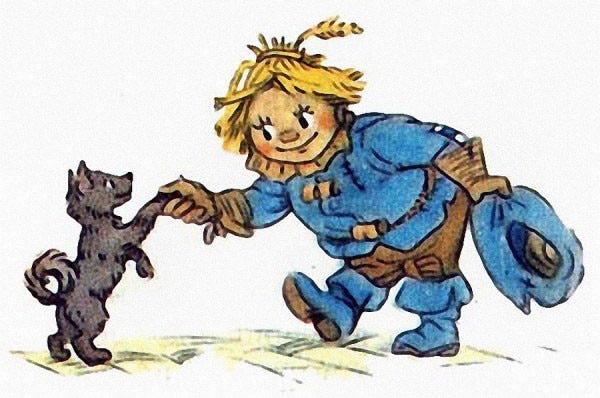
I found a source in Russian that tells the story of how Volkov began writing — and how old he was when he wrote his last stories.
In 1936, a 45-year-old professor of advanced mathematics at the Moscow Institute of Non-Ferrous Metals and Gold decided to learn English in addition to German and French. Fortunately, free courses had been made available to employees of the Ministry of Non-Ferrous Metals. It was there that he was given an original edition of Baum’s “The Wonderful Wizard of Oz” for extracurricular reading.
The mathematician liked the book and decided to translate it. A few years earlier, the Organizational Bureau of the Central Committee of the Communist Party had issued a resolution “On Children’s Literature,” which called for the publication of more good books for pioneers and schoolchildren. In 1939, pioneers and schoolchildren were able to open a book that began with the words: “The Wizard of the Emerald City. An adaptation of the fairy tale by American writer Frank Baum, ‘The Wonderful Wizard of Oz.’ Retold by Alexander Melentyevich Volkov”. The book was illustrated, but the illustrations weren’t outstanding. Volkov himself was nearing 50 and felt the project was done.
Then, the Second World War started. Not many people cared for children's books anymore. Volkov’s book didn’t blow up, but a lot of other stuff did.
But later, in a different historical era, in 1957, the illustrator Leonid Vladimirsky revived The Wizard of the Emerald City, making it a bestseller. Leonid had just made a name for himself nationwide with his illustrations for the fairy tale The Adventures of Buratino and was looking for another story to illustrate.
Browsing in the library, he found an old book, printed before the war, not too popular then, already forgotten now. He drafted a couple of illustrations and received an advance payment from the publisher right away due to the success of Buratino. Then Leonid started looking for the author. He found Volkov at his summer house, surrounded by children and grandchildren, not too keen to remember the whole translation gig. But since he liked the illustrations, Volkov agreed to reprint the book and even edited the text once more. By that time, he was close to 70.
The book became mega-popular. Volkov was repeatedly asked to adapt something else from Baum. This is when he went to the library to check out other volumes, got disappointed, and began writing on his own.
At 82 years old, Volkov opened his diary, re-read the line “American writers have an amazing passion for extremely long series,” and confessed under it: “I myself later fell into the same sin!”
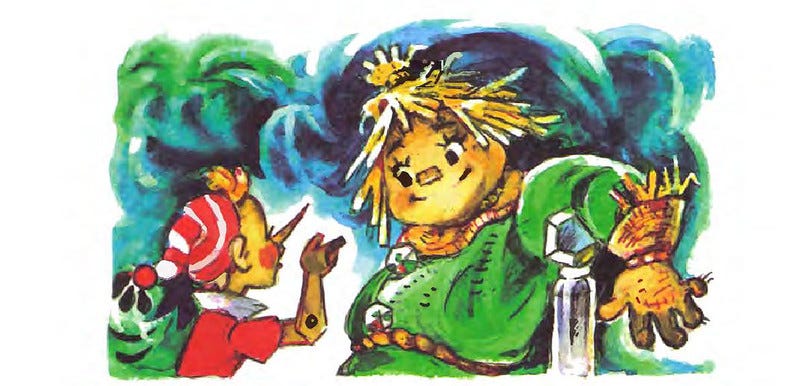
Later in 1996, Leonid Vladimirsky, the star illustrator of both Buratino and Emerald City, wrote, illustrated, and published the crossover “Buratino in the Emerald City”. He loved both stories and wanted to combine them into a single set of illustrations.
Sometimes the pull of the story is too powerful. You cannot resist, so you must create a fanfic.
On Soviet Children’s Literature
An excerpt from “Growing Out of Communism-Russian Literature for Children and Teens, 1991–2017” by Andrea Lanoux and Kelly Herold:
The sharp 180-degree turns that Russia has undergone over the past three hundred years have had a significant impact on the literary landscape, giving rise to alphabet reforms under Peter the Great in the early 18th century, radical experiments in literary genres in the 19th century, and the publication of revolutionary children’s books in the early 20th century.
That same innovative impulse once again led to the creation of new literary forms for children and adolescents following the collapse of the Soviet Union and the social changes that marked a rupture between the past and the future.
The processes contributing to the emergence of new literature unfolded in a similar manner: changes in the political sphere triggered a flood of translations of Western texts into Russian. This was followed by a wave of imitative literature written in Russian, after which new, original literary works emerged.
In all cultures, childhood is a difficult time; in the eyes of the law, children are not considered independent subjects. They are not merely wards of the adults who care for them: children are strongly influenced by their parents' decisions, not to mention the values of that particular society. Similarly, the situation with children’s literature in all countries is complicated by the fact that children themselves rarely write children’s books: no matter how hard adult writers try to express what children experience, they convey culturally rooted, fully formed conceptions of life to readers who are only just beginning their socialization within their communities. From our perspective, this complex act of transmitting cultural values transforms children’s literature into one of the most important and compelling cultural artifacts ever produced by humanity.
It is difficult to find a body of work more overtly ideologically charged or more ambitious in achieving its goals than Soviet children’s literature, produced between 1917 and 1991. Aimed at the education and socialization of future citizens, the Soviet children’s literature industry grew incredibly and created a vast, fully state-controlled system consisting of publishing houses, distribution networks, school curricula, bookstores, children’s libraries, academic journals, and graduate programs dedicated to its study. By 1991, approximately 1,800 book titles were published annually in the Soviet Union, with an average print run of over 200,000 copies; in total, between 350 and 400 million copies of children’s books were published each year. Such enormous print runs, combined with coordinated efforts to raise children in a unified ideological spirit and a population which generally valued reading and education, ensured that in the Soviet Union the majority of children read the same books and absorbed the same ideas about what it meant to be citizens of the world’s first socialist state and a global superpower.
Never before, anywhere, had such coordinated efforts been undertaken to instill a universal body of knowledge among children and adolescents through a cultural canon developed specifically for this purpose. By the end of the Soviet period, beloved children’s heroes such as Doctor Aibolit, Cheburashka, Crocodile Gena, and Uncle Fyodor embodied the very idea of Soviet childhood, and their diverse adventures and the plotlines of the corresponding books became part of the cultural fabric of millions of Soviet children. A remarkable feature of these characters was that they fully conformed to the regime’s ideological requirements while at the same time striking a deep chord with both children and adults.
It was a dual process—state support from above and immense love from readers below; it was precisely this duality that made them canonical figures. The Soviet canon of children’s literature—a vast body of texts rooted in material reality and common social practices—was remarkable precisely for its astonishing resilience.
Thank you for reading 🫶🏻
I am happy to hear your thoughts — in a comment or email.
I loved reading this. A whole new world to me, thank you.
Доктор Офболи (in our translation)! I have forgotten about him :) I loved the book growing up. It’s very cool seeing this exposure of the roots of the books I grew up with and never have thought to research.