
Creative Workarounds
freedom as a technical issue
Oleg Dorman, filmmaker and scriptwriter, recalled:
As a student of Semyon Lungin, one day I was sitting in his kitchen. We were working on a script together.
His wife Lilianna Lungina — the woman who translated Karlsson-on-the-Roof by Astrid Lindgren from Swedish and who had been laboring over a new translation in the next room — walked in.
“Boys,” she said, sounding frustrated, “a character is walking through an airport, holding something called a ‘hamburger.’ I have no idea what that is.”
“Sounds like a type of raincoat,” said Lungin. “Some kind of jacket, probably.”
“Alright,” Lilianna brightened. “I’ll write that he tossed it over his arm.”
A few minutes later, she returned. In a completely defeated voice, she announced:
“He ate it.”
I love this story. It explains, in a couple of paragraphs, the life of a Soviet translator — no internet, no connection to the reality of the world you're describing in another language, and often no relationship with the author to get answers from. This, of course, sometimes brought funny and awkward additions into the translation.

The rules
Another nuance of Soviet translations is that the book’s author did not consent. In the USSR, there was no private property. You lived in a state-owned apartment, and authors did not decide whether their work was translated — even those who lived in capitalist countries.
If the Soviet state decided your work should be available in Russian, it would be translated and sent to libraries. You might find out later. Or not.
This meant that:
Foreign authors weren’t paid — even if their book was a hit in Russia, printed in millions of copies.
The result might be heavily censored, stylized, edited to increase the socialist vibe, or freely rewritten in translation.
If a translation was needed, the translator had to find ways around things — even if they didn’t know the language a book or poem was written in.
To give a reader the “literary experience”, rough sentences could become more philosophical, as happened with “The Catcher in the Rye”. Instead of teenage angst, exceptionally talented Rita Rait-Kovaleva gave Soviet readers a melancholic, slow, thoughtful story. She used a richer vocab, too. The word "terrific," which Holden uses a lot, was translated in 14 different ways throughout the book. “Goddam” got 20 variants.
Rita even created a better (in my view) title: instead of a figure of the catcher in the field, I have a figure moving dangerously close to the cliff. The title, translated, reads: “Above the abyss in the rye.” The abyss is existential. It fits the philosophical translation so well.
Unusual items on the way were replaced either because the reader didn’t know them or because the translator didn’t. “He’d even pick up your jock strap or something” became “He could have picked up anything, even your shoelaces.” A pinball machine became a roulette, Ivy League became an “aristocratic fraternity,” the Cuban-looking guy became a Spanish one, and a double date was downgraded to just a date1.
Rita Rait-Kovaleva was well known as a person with impeccable linguistic intuition. The famous immigrant writer Sergei Dovlatov remembers working as Vera Panova’s secretary, who asked him who wrote best in Russian. He answered immediately: Rita. The next thing Dovlatov touches2 on in his memoirs is Gore Vidal’s visit. Gore drops this banger:
"Kurt Vonnegut sounded worse in the original."
He, of course, references the Soviet literary tradition of elevating the translation, so “not even a mosquito could sharpen its nose on it,” as we say. Was the quality of the translation the reason for Vonnegut’s popularity in the USSR bigger than in the country of origin?
Knowing Salinger only through the Soviet translation for a decade, I was excited to read the original once I’d reached a better level of English. Let me tell you, I hated it. All the existential edge I related to as a teenager was missing. It was an all-boys locker room, boring as hell.
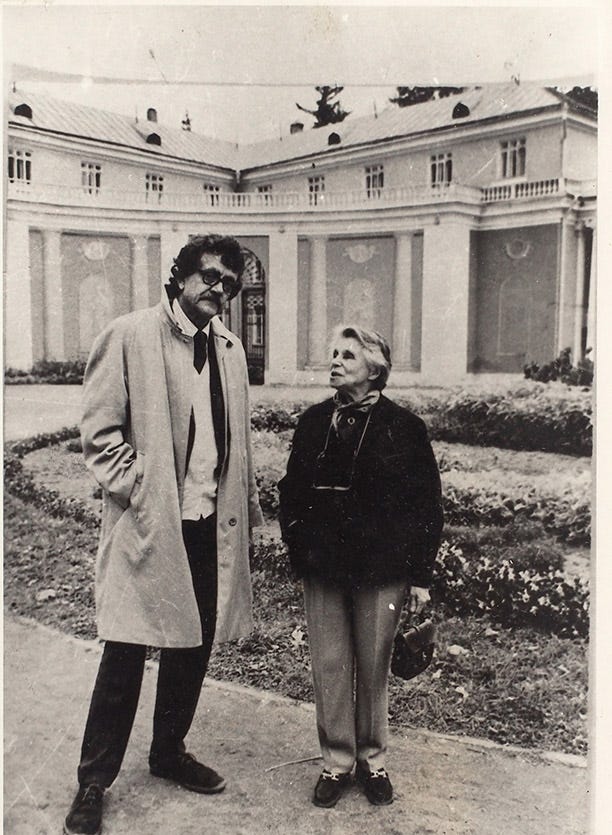
A holy trinity of the Soviet bookshelf: Exupéry, Salinger, and Vonnegut.
I didn’t attempt to read Vonnegut in the original. I loved the translation, though. Of course, I did. It was Rita who worked on it.
Two types of pain
An example that works in the opposite direction is Vladimir Nabokov — the only writer considered both a great Russian author and a great American one. After finishing Lolita in English in 1955, he decided that no one else could translate it better into his native language. So in 1957, he sat down and did it himself.
Before, he complained about writing in English. In the afterword to the American edition, he said: “I had to abandon my natural speech, my unconstrained, rich, infinitely obedient Russian style, for a second‑rate sort of English.”
But then, during the translation back to his native language, he got even more baffled.
There were a lot of hard decisions to make. The reality he managed to describe in English, although cursing on the way, was American. The Russian he remembered didn’t have established words for many regular objects of his new country. It was not a walk in the park to fit an American-born Lolita into his before-revolution aristocratic Russian.
He transliterated some terms (like “drive‑in”) and translated others (like “jeans”) descriptively ( “blue cowboy trousers”3). Time flies, and both choices now read strangely — “drive‑in” never became a Russian word, but “jeans” did.
Instead of “sneakers,” his protagonist in the translation wore “canvas slippers4.” A single word — “cheerleader” — turned into a twenty‑word monster:
“Bare‑legged girls in short skirts and thick sweaters who, with organized shouts and gymnastic frenzy, encourage the students playing American rugby.”
In the afterword to the Russian edition, he complained again:
“Alas, that ‘wondrous Russian language’ which, it seemed to me, had been waiting for me somewhere, blooming like a faithful spring behind tightly locked gates — gates for which I had kept the key for so many years — turned out not to exist. Beyond the gates, there is nothing but charred stumps and an autumn horizon of hopeless distance. And the key in my hand looks more like a lock pick.”
Under-the-line
If you are not translating your own book, before deciding how to shape the outcome, you need to understand the original. What if you are tasked with a language you don’t know well, or at all? In these cases, Soviet translators had to work with a podstrochnik — a rough, word‑for‑word translation.
First, someone who knew both languages but wasn’t a writer or a poet would create a literal, word-by-word translation called podstrochnik (literally “under‑the‑line,” because each translated word was written directly under the original). Then a professional poet or writer who might not know the source language at all would turn that rough draft into a full‑fledged literary work in Russian.
As a consequence of this arrangement, the voice of the resulting text leaned closer to the translator than to the original author. Of course! The editor might have never read the original because they might not have known the language.
Another possibility was that translators who knew, say, Polish could take on texts from Czech or other Slavic languages, relying on linguistic similarity and the help of editors.
One loophole some Soviet editors used was to add a loud, activist-sounding introduction that might satisfy the censors. If the censors got bored, they might not read the actual text — and allow something that wasn’t fully in line with the rules.
One example is The Day of the Sardine by Sid Chaplin — I found it in the library, translated into Russian in 1964.
The introduction is typical hurra-patriotic talk about workers’ rights. And the book is definitely set in a working-class community in Newcastle upon Tyne. But it’s also full of teenage angst, complicated feelings, and the suspicious similarity of people everywhere — without any supremacy of socialism.
The “World Literature” Project
You probably didn’t have to memorize Maxim Gorky’s complex poetry in school over the weekend. What I didn’t know while rehearsing the “Song of a Falcon” (not without tears, as it didn’t rhyme, making it difficult to remember) was his monumental translation project. Because of the First World War, it wasn’t finished, but hear me out.
A publishing house was founded in 1918 on the initiative of Maxim Gorky under the People's Commissariat of Education. The goal was to translate and publish in Russian the best works of world literature from all eras and peoples (about 4,000 volumes were planned). No author’s payment, copyright, or consent, of course. But all for the good cause. To build literacy and give simple, uneducated people a great, diverse culture to learn from.
The project launched amid the Civil War, economic ruin, and famine. People were literally starving. The idea of translations to feed people intellectually was challenging and perhaps far-fetched, but nevertheless visionary. The industry was excited.
Gorky assembled the professional team. These were the best writers, philologists, and translators of the Silver Age, many of whom remained in starving Petrograd (later called Leningrad, now St. Petersburg). They worked in the publishing house on the Fontanka Embankment. They sat in the cold, went hungry, but they translated.
With hunger, economic collapse arrived. There was no food; that was fine. Work continued. But then, there was no paper. Factories stood still. And another minor detail: the potential readers were starving and not really focused on reading.
In 1921, Gorky was forced to emigrate. Instead of thousands of volumes, only up to 200 small books were released.
But the idea didn’t perish.
Samuil Marshak, another poet I had to memorize a handful of works from, too, worked under Gorky in charge of the children's department for that monster project. In the 1930s, when Gorky returned, Marshak was appointed to head the editorial department of Detgiz (the State Children's Publishing House) under his leadership. The literacy and education work continued. The future was targeted — children should read great literature and grow with it.
Viktor Shklovsky said:
“Samuil Marshak understood that many new writers would appear in the new Soviet republic. He stood at the door of literature, a benevolent angel, armed not with a sword or with a pencil, but with words on work and inspiration.”
In his role as editor, Marshak attracted some of Russia’s best writers to write for children, including Evgeny Schwartz and Oberiu member Daniil Kharms. It was a great backdoor tactic for creatives who hated to be the hand of propaganda. They created amazing, creative, absurd pieces for children instead, avoiding the censorship that was inevitable in the adult department (one day I’ll tell you about the crazy magazine called The Tram).
In the 1960s, there was another Soviet attempt to “translate everything that is good in world literature.” The Library of World Literature, in 200 volumes, was being published slowly as a continuation and realization of initial Gorky's vision.
But this was no longer the free project of 1918. The Library was strictly censored. It excluded James Joyce or Franz Kafka (too complex and/or pessimistic) and Russian émigré philosophers. And the Library wasn’t easy to acquire. You couldn’t just enter the bookstore and buy 200 volumes. It was the Soviet times, after all. Everything good, you needed to find. And it took time, connections, and luck.
The Library of World Literature was available by subscription. By paying in advance or in installments, you would get one volume at a time over a decade, or get it at your local library.
In the 80s, libraries still had many great books. And I had different volumes at home, growing up with African and Scandinavian fairy tales alongside Soviet stories. We weren’t in full literary isolation, even though the Iron Curtain limited our mobility, and the books we got were carefully chosen and translated in ways that authors did not always anticipate or even know about.
I loved my local library, and I checked out ten books every time.
I still have this habit. Libraries in Berlin are amazing, and my 10-euro-per-year subscription allows me to listen to audiobooks for free.
Thank you for reading 🫶🏻
I am happy to hear your thoughts — in a comment or email.
https://lit.wikireading.ru/50964
https://magazines.gorky.media/inostran/2009/7/selindzher-nachinaet-i-vyigryvaet.html
синие ковбойские панталоны
полотняные тапочки
It's very interesting that you hated Vonnegut's original. I hated the translators who lied to me once I read the originals.
The work of the translator (in my view) is not to make the original "better" and certainly not to embellish it with all kind of synonymous and "deep" meaning. The work of the translator is to read as closely as possible, understand the text and to produce a text as close to the original as possible in the other language. English has many more words than Russian, if the author wanted more words, they would have used them, if the author wanted existential, they would have done that. Each writing has its purpose and does the work in its way. Not everything should be reduced to the style the translator prefers (even for political reasons).
I'm still very cautious about Russian translations and prefer English ones for books I can't read in the original language. Even now, I hear some Russian translators brag how they "fix weak parts of the original, if they see it". A very bizarre tradition (to me, again).