
Performance and gatekeeping
Memories of a senior tech worker
I started working in tech before I graduated from the university.
I studied computer science at a time when it was evolving every day. You’ll say it evolves now, maybe even more quickly. But that was before everyone got a smartphone and AI became a regular topic of conversation over dinner. There were people who knew tech and people who didn’t.
At the beginning of the 2000s, your internet would come with the pssshhhh sound of a modem, and your “home page” would likely be created by hand using <body> and then <head> and then </head> and then </body>.
In those old times, when you were looking for jobs, “PC operator” as a skill (together with name-dropping of MS Word and MS Excel on your CV, just the sheer fact of having used them) would take you places. At least in Moscow, where I was born, grew up, and graduated before moving to St. Petersburg.
My university taught me what bloggers now have to learn on their own: what data is, how information is transmitted online, and how to use this or that service.
But my education was too theoretical and always outdated. Professors complained that textbooks made no sense by the time they were printed, and that they had to rely on their own research. Some important tech areas weren’t covered at all, because they had only recently emerged or become prominent. Higher education chased reality but couldn’t catch up. I bought a thick manual on HTML 5.0 and built a website on my own during my holidays.
We had subjects like Databases, Information Law, Engineering 101, and Information Services. We also had general development subjects like Economics, Social Psychology, Philosophy, Consulting, and Concepts of Modern Natural Science.
Compared to uni systems in some other countries, we couldn’t choose or drop some subjects. We needed to get good grades in all the courses to pass the year.
By my third year (out of five) at the uni, I figured out I could juggle a side job while keeping my grades up. I was a bit bored and hungry for real-life problems to solve with my newfound structural knowledge.
(By this day, the 3 principles of database health are my core beliefs and personal values: data integrity, consistency, and completeness)
I easily found a job at a website-making agency. It happened on February 14, and I was joking that I just love working so much. It was true, though. I do like working.
At the agency, it started well, but they went bankrupt soon, so I had to find something else. With the practical experience I gathered (copywriting, managing projects and stakeholders, working with content management systems, etc), it was easy.
At a promotional event at my university, I was initially promised that my future job as a computer science major would likely be “digitalizing libraries.” Our headmaster’s imagination didn’t go further than this. But just in three years, I was welcomed everywhere. My career was blooming, and I wasn’t even 25.

When I tell people in Germany that I had built and lead the department of 40 employees, hiring and onboarding every one of them, many older than me, being just 22 years old, having zero guidance or mentoring or leadership training from anyone in the company (because no one knew how to do internet correctly and we were creating the playbook as we tried and failed), no one believes me.
But it was like this. Every month or two, higher-ups would say, "Your company needs you to step up,” and you did, knowing that otherwise you would be bullied as a scaredy-cat or fired. You would enter the roles you didn’t want until you’d burn out, and they'd quickly replace you with another 22-year-old ready to prove herself.
This was the way to gather good experience, build enormous resilience, and cover areas you never knew you could excel in.
This was also the way to become extremely self-reliant, believing that asking for help shows weakness.
Sometimes I think children of post-communist countries inherit two conflicting things at once: enormous resilience and enormous emotional weight.
— Linda Alia, The Unbearable Heaviness of Being Raised by Post-Communist Parents
I’ve grown since, again and again, acquiring new soft skills (see my post on 10 years of personal therapy), learning how to ask for help and stop burning out. I learned that I should never have only a job, but I need a pet project on the side to write and keep my sanity.
But I’m still operating from the body of a person who first had to parent their own parents when their whole country broke down (see my post on growing up in the 90s, and also the book “Adult children of emotionally immature parents”), and who then needed to build a career without support, on curiosity and wit.
It wasn’t only me who was doing things without a safety net, learning on the go. Everyone was like this, so it didn’t feel weird at all. It was exciting to be able to touch tech stuff anyway.
In the 2000s, the meme “slaboumie i otvaga” appeared (see below). It describes the needed skills perfectly. You should have had both “silliness of mind” (not being too serious or rigid with your thinking, otherwise you’d step back from the risky stuff, and everything was risky in these circumstances) and “courage to run into anything”.
The perfect visualization was Dale, the unhinged chipmunk from the Disney series that I’d watched over the weekend as a teenager.

You shouldn’t expect Europeans to take you seriously if you mention “Chip and Dale.” Many Germans laughed, thinking I had watched Chippendales, the male nude dance troupe, over the weekend as a teenager. I didn’t.
But Germans didn’t watch Chip and Dale's adventures. They watched Chip und Chap. In France, Tic et Tac. In the Netherlands, Knabbel en Babbel. I love localization.
The original Monterey Jack, whom I know as Roquefort, was called Samson in Germany and Jack le Costaud in France.
Don’t let me start on the other ones, because I have a spreadsheet.
Huey, Dewey, and Louie from Duck Tales? I don’t know them because I watched Billy, Willy, and Dilly. Germans know Tick, Trick, and Track. The French know Riri, Fifi, and Loulou. And in Spain, they were Juanito, Jaimito, and Jorgito 🥹
Industry gatekeeping
When I started working as a project manager, I didn’t have any certifications to prove I was qualified. I just got a lot of work, and I learned on the go.
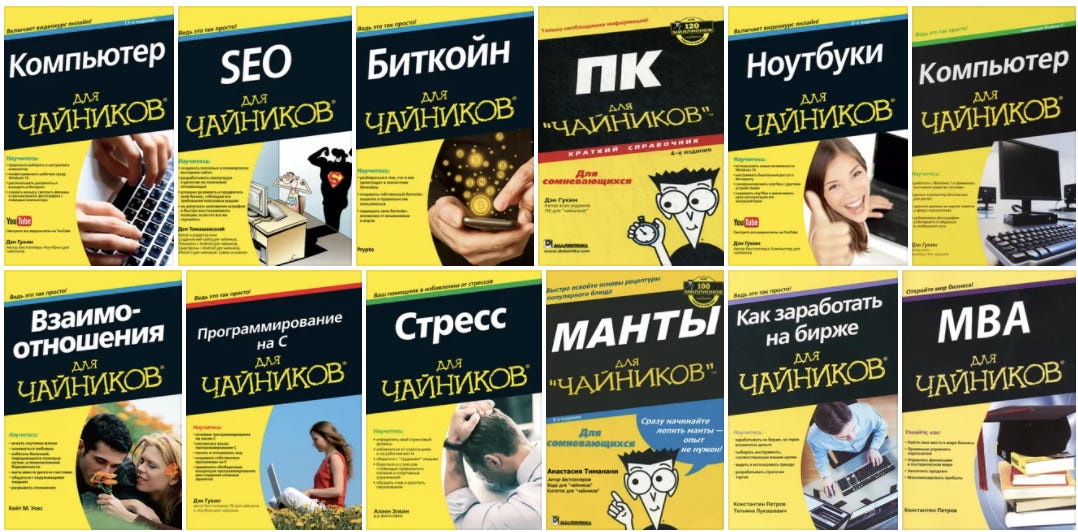
I remember buying the translated book “Project Management for Dummies” (in Russian, it was called “Project Management for Tea Kettles” because a newbie would be called a tea kettle) and making notes. But there was no test. I had one interview with the hiring manager and was told to start the next day. And so I did.
Next jobs were obtained in a similar way. I would learn about the opening, speak with a hiring manager, and start the next day. At the latest, in two weeks: the notice period in Russia for all ranks is two weeks by law, not notorious 3 months like in Berlin.
Ten years later, all the tech companies started copying Google-like interview techniques, trying to prove that they hire the right people. Getting in became tougher. Google would have already dropped the question about the manhole cover, but tech corporations in Russia have just integrated it into the process.
My last tech office job in Russia was at a big corporation, as an individual contributor (I was a PM on a team of 15 engineers). I was hired in 2015 and stayed there for 4 years. I was keen to join because I loved the idea that the main KPI for a 10K-employee corporation was “the happiness of the customer.” The hiring process lasted 2 months, involved 9 interviews across all levels of seniority, and felt never-ending.
Truth is probably somewhere in the middle, between giving a department to a 22-year-old without support, and rolling 9 interviews in two months to hire a PM with 10+ years of experience.
But the result of the industry becoming increasingly regulated and serious was that we moved away from the initial joy and curiosity I enjoyed so much in the beginning.
I see how certificates and bootcamps now serve as a seal of trust, because it is easier when everything is standardized. But I am sure that a mother who had to manage three kids’ schedules for years is a better PM, even if she has to learn some lingo, than any young person who just managed to get a PM certificate. As a hiring manager, I appreciate practice way more than theory, and I see how the industry prevents people from entering. On a scale, everything becomes less human, more generic. Play goes out of the window.
But all the learning material is theoretical. Stakes are too low. For real deal, you need some good old “slaboumie i otvaga,” not a certificate. To get better, you have to fail, and to be able to fail, you need to enter the field. The more standardized everything becomes, the smaller the margins for error, and thus, for both play and experiment.
Performance and professionalism are taking the space.

Professionalism
In Russia, tech started in opposition to serious business. It challenged the status quo. In the publishing house, the newly founded tech team I worked on was a rival to the traditional newspaper ad team. We needed to prove our worth and show everyone that our silly internet actually brings clients. So we dressed as underdogs, highlighting the difference.
Even in fintech, founders and C-level execs flaunted T-shirts and jeans instead of adhering to the suit hierarchy. People in the banking and oil industries were allowed to wear jeans on Friday. We had a Friday every day, addressing management by the first name, and in the form of a diminutive.
Tech companies prided themselves on not having a rigid structure. Being creative meant having a beautiful, Google-like office, free berries and sandwiches at the coffee point, or at least a free/discounted lunch.
During my work at the corp in Russia, where I was the only PM with 15 engineers, I was also the only person arriving at work at 9 am. I enjoyed the quiet and calm of the mornings. I enjoyed leaving at 6 pm. Some colleagues managed to arrive around 12, by which time I was already off to have lunch. Others were as late as 3-5 pm, staying in the office at least until midnight, taking a taxi both ways. As a PM, it was a pain to set up a team meeting. Whenever I would plan it, one or two people would be late, running out of breath.
This relaxed attitude was considered another value of the corporation, adding to customer happiness: the ease of rules for employees. Engineers were hired fresh from elite universities, at the top of their class, great mathematicians, and excited to work with big data. For many, or for most, work was their main hobby and passion.
I’ve heard hiring managers say that if an engineering intern is not willing to work for 16 hours straight, he is not invested enough and needs to be let go.
I was a PM. It didn’t apply to me.
My engineering colleagues were sure I didn’t have enough brains to get the real job, an engineering one. And a woman on top of that! They pitied me, a less fortunate peer of theirs. But I had life outside of work and didn’t mind.
I worked well, foraged berries at the coffee point, ate the free lunch, and went home at 6 to produce a podcast and meet my friends. I used my salary to support local businesses and travel. I knew the field, and I found the safe spot to afford a good life.

In 2022, after finding a job abroad and moving to Berlin, I realized my understanding of the field was very provincial. My new, international company, way smaller than the corporation I’d worked in before emigration, had way more unspoken rules about what counts as professional.
It was discussed often because I apparently was missing the mark. My communication skills, something I prided myself on, were suddenly lacking. But they weren’t. I just didn’t know how to adjust to the new context. They also didn’t know. I had to figure this out on my own, or fail the probation and leave.
The things I’d attributed to being a successful senior manager in my previous work life were now seen as immature. Making quick decisions as a person responsible for a domain without “aligning” and then “aligning” again. Approaching anyone from the company without going through the whole hierarchy first. I felt like I was working in a bank now, even though everyone spoke about flat hierarchy and the democracy of a startup. The only thing missing was a suit.
I was told I interrupted people, which was insulting and not befitting a senior professional. I sat with this information, did some research, and asked around. The problem was “turn-taking,” as I learned during a webinar led by someone who had previously been responsible for international communications at General Electric. In my culture, we interrupt each other, also at work, as a sign of being immersed in the conversation. Here, I came across as lacking patience.
I had a team meeting where I started playfully pushing a senior engineering colleague, who was also Russian-speaking, although from another country. He playfully pushed back. We went into irony and sarcasm and came back renewed, quickly reassigning the rules among ourselves and solving issues easily. We thought European colleagues saw the situation similarly. They later complained to management that we were disrespectful, yelled, were scary, and took up too much of everyone’s time. I was dumbfounded. The way I knew how to solve problems, the way that worked for my colleague as well, was out of the question for others. I had to adjust, and so I did.

I am still the same person. I just know how to be professional in another context now.
I learned that even Slack messages should be timed and rewritten 10 times for length and clarity. At my last Russian office job, anyone would just send a quick “hi I need help with this thanks” without formatting, and no one would think they were not senior enough. It wasn’t relevant to the topic of professionalism. Here, the rules are different.
It took some ego work to accept that, having 20 years of industry experience under my belt, I might be seen in a new context as unprofessional or not senior enough because of my choice of words, timing, facial expressions, or body language.
I learned that Russian speakers are often criticized for “long, boring, slow, unstructured speaking”. Well, maybe we were hoping you’d jump in to co-create the conversation with us! But you waited and kept your silence, of course, we felt the need to continue speaking because it looked like you needed to hear more, or again.
I did my homework and started giving shorter, more concise reports. I learned to say “this is it from my side”, something I never needed back in my home country because I would never have needed it. And I learned to keep my quiet until another person stops talking, even if I’m already bored to death.
Moving from one context to another, we learn to shape-shift and code-switch. We, immigrants, have many playbooks available. We can be different people.
Some of my lessons were painful, but I am grateful to have taken them.
It’s just that I miss the play a little. This is what my Substack is for.
Thank you for reading 🫶🏻
I am happy to hear your thoughts — in a comment or email.
Hey, super interesting. Where did you work both in Russia and Germany? I also come from St. Petersburg but had a very different feeling about work there and in Germany. I might be a bit yonger though.
Spot on! When I was studying economics in Bulgaria in the early 1990s, all our professors knew was how to teach the communist-endorsed planned economy, which by then was already becoming obsolete. Then, all of a sudden, they had to start teaching market economics.
So what did they do? They gave us textbooks in English, and instead of exams, we had to translate a few chapters from those books into Bulgarian. We were just kids who had learned conversational English through evening courses or private lessons, so you can imagine how accurate our translations were. In those early 1990s, the job market was so chaotic. I've said this many, many times before, but we were all just improvising.
Interestingly, my latest piece on Substack is also about my professional endeavours, and I touch on many of the same themes you write about, but from a different perspective.
Curious to see what you think.